



I got a mortgage rate quote a few weeks ago that made me stop and reread it twice. Not because it was shocking. Because it was just a little higher than the last one, for reasons nobody in the room could fully explain. The loan officer shrugged. “Rates are just moving right now.” That’s the kind of sentence that used to satisfy me. It doesn’t anymore.
That bothered me enough that I started pulling the thread. If the person across the desk couldn’t really explain the move, something else was setting that price. So I went looking for it.
That number didn’t start with my lender. It sits inside a much larger pricing system, one that stretches back through the Treasury market, and further back than that, to a country most Americans never think about twice.
Here’s the condition that built the system.
For almost thirty years, Japan kept interest rates near zero. Sometimes below zero. If you were a Japanese pension fund, an insurer, a bank, holding cash at home meant earning almost nothing. So a lot of that money went looking for a return somewhere else. That’s the part people usually stop at: cheap Japanese money bought foreign bonds, including a lot of American government debt.
But cheap Japanese money didn’t just buy foreign bonds directly. It let other people borrow it and do things with it too.
For years, an investor anywhere in the world could borrow yen at almost no cost, convert it into dollars, and invest that money in something that paid more. This is called a carry trade, and it worked because the cost of borrowing yen stayed low and predictable for a very long time. Hedge funds used it. So did banks. So did ordinary portfolio strategies that never mentioned Japan by name. Cheap yen turned into a load bearing assumption for global finance, and most of the people relying on it never thought about Japan at all.
Nobody planned this as a system. It just happened, and it worked well enough for long enough that people stopped noticing it was there.
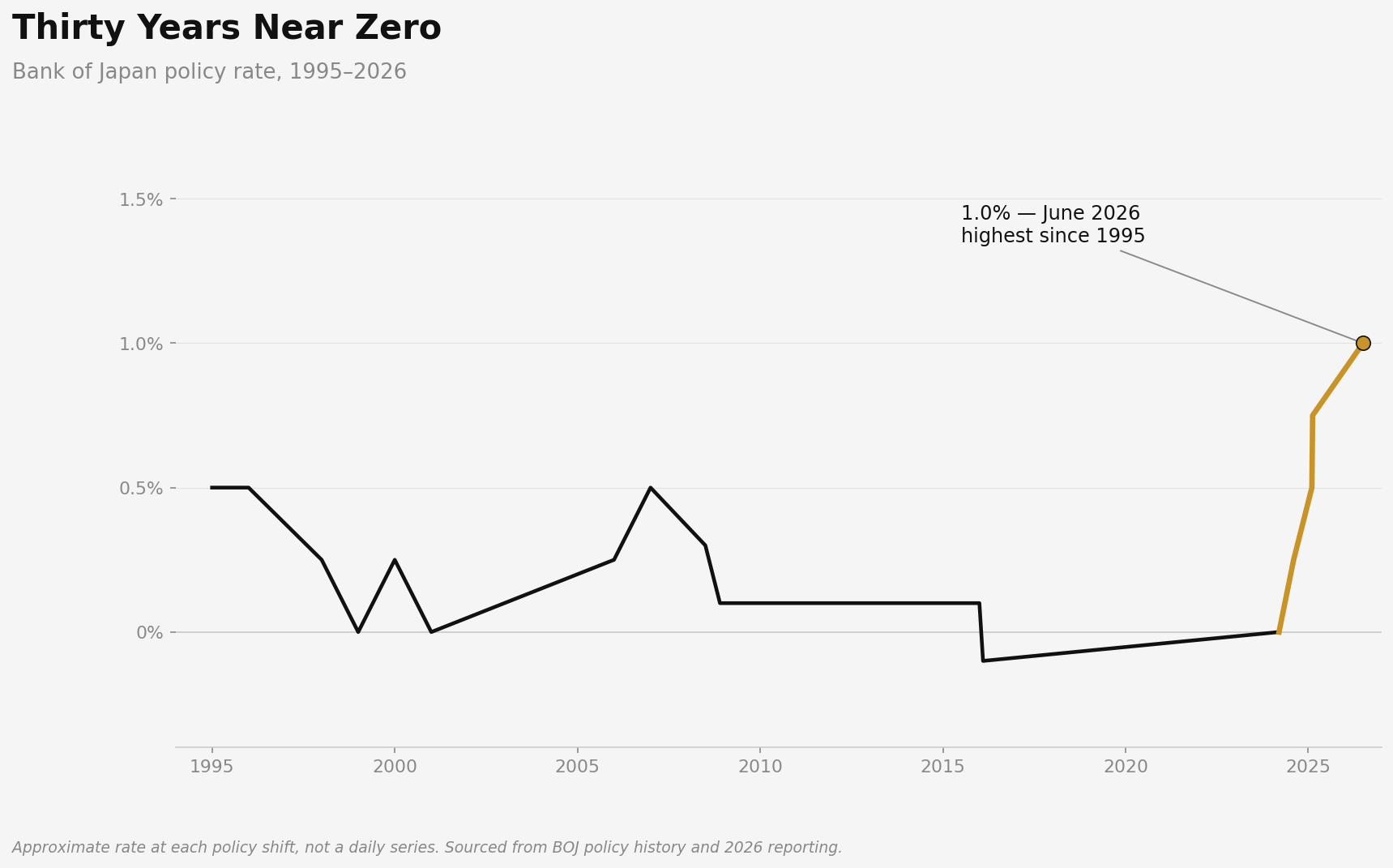
This year, that condition started to loosen, which is a different thing than collapsing.
The Bank of Japan raised its policy rate to 1.0% in June, the highest it’s been since 1995. Japan’s own government bonds recently reached around 2.8%, a level the country hasn’t seen in almost thirty years. For the first time in a generation, a Japanese investor can earn a meaningful nominal return at home, in their own currency, without reaching across the ocean for it, and without borrowing yen to fund a bet somewhere else.
This doesn’t mean Japan is walking away from America. Japan still holds over a trillion dollars in U.S. Treasuries and remains the single largest foreign holder by a wide margin. What changed is smaller and more telling: in the first quarter of the year, Japanese investors posted their first net quarterly sale of U.S. government, agency, and municipal debt in over a year, breaking a run where they’d been net buyers in eleven of the previous twelve quarters. It’s a modest slice of their total holdings. I’m more interested in the direction than the size.
The strain showed up somewhere else too, somewhere much harder to look away from. In late July and early August, the yen fell to its weakest level against the dollar in roughly forty years. Japan and the United States responded with a coordinated intervention, buying yen together to stop the slide. That’s not something two countries do lightly. It had been almost thirty years since the last time they did it together.
None of this required a headline about Japan to reach you. It just arrived as a slightly worse number on a piece of paper, with a shrug attached.
You don’t need to become a Japan expert to keep track of this. A few things are worth watching, not as forecasts, just as signals of whether this keeps moving in the same direction.
Japanese rates. If they keep climbing, staying home keeps getting more attractive for Japanese capital.
The yen. Persistent weakness pressures Japan to keep normalizing policy. A stronger yen changes the math on borrowing it cheaply to invest somewhere else.
U.S. Treasury yields. This is the part that actually reaches you. When it costs the government more to borrow, everything else that borrows money tends to follow.
The spread between Japanese and U.S. yields. Honestly, this is the one worth watching above the others. The wider that gap, the stronger the pull for Japanese money to leave Japan. When it narrows, so does the pull.
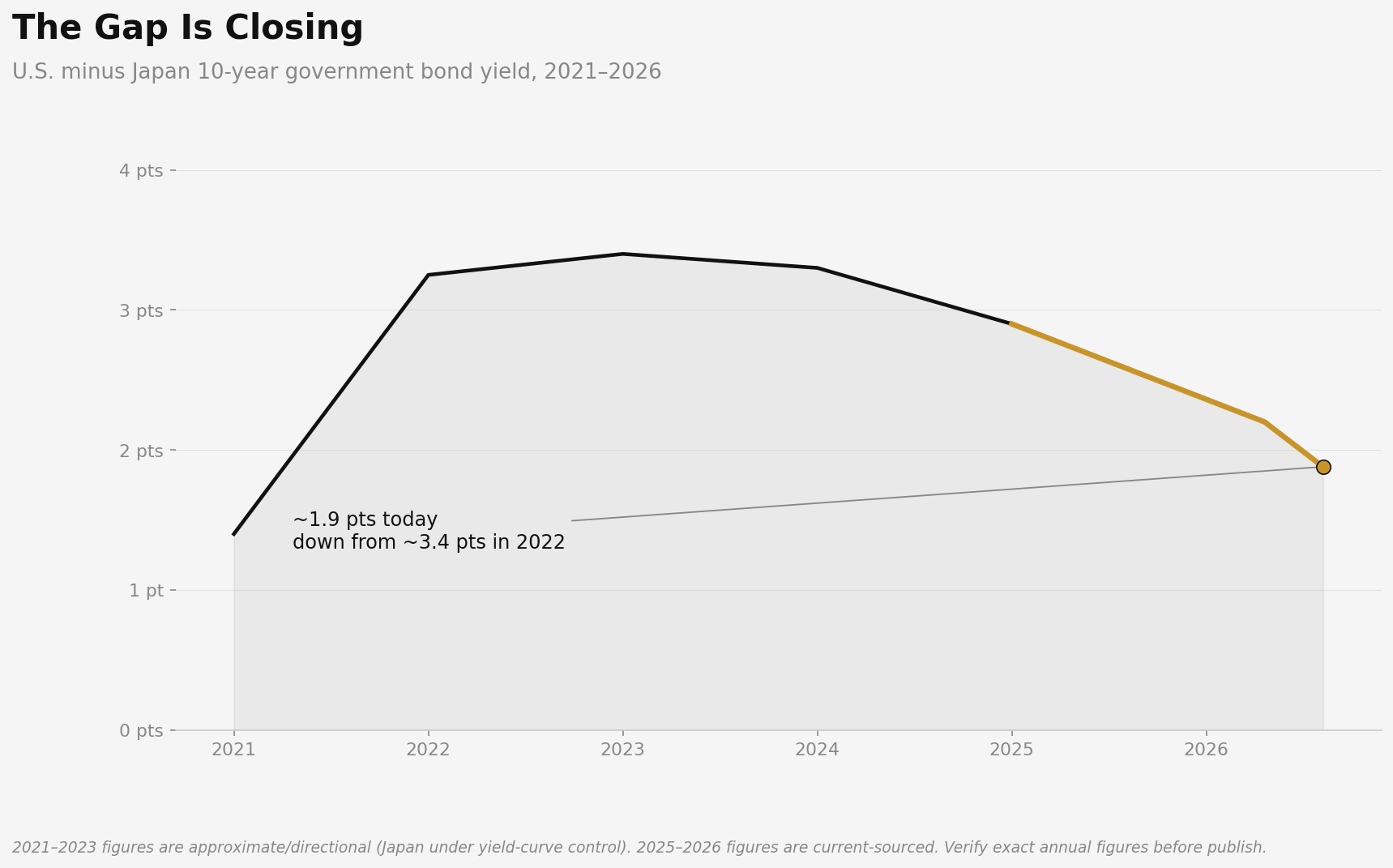
You don’t need to predict what Japan will do. You need to notice when the incentives change.
I don’t think this ends in a crisis, and I’d be doing exactly what I dislike in this space if I told you it did. Predicting collapse is easy content. It also lets the reader off the hook, because a coming disaster feels like something to brace for, not something to understand.
Here’s the version I actually believe, even though it’s less exciting to say. A financing condition that quietly held down the cost of money for three decades is loosening, one policy meeting and one intervention at a time. It doesn’t show up as an announcement. It shows up as a Treasury auction that needs a little more yield to clear, or a mortgage quote that moves for reasons nobody at the desk can fully explain. Most of us never thought about the cost of money as something that could change. It can.
The practical point is simple: if you ever borrow money, invest money, or just live in an economy that borrows trillions of dollars a year, this touches you. Even if you’ve never once looked at a Japanese interest rate.
I’ve spent enough time inside financial systems now to know this is usually how real shifts happen. Not with an announcement, but with a quiet change in who’s buying, who’s borrowing, and who’s suddenly not there in the same way anymore.
What I find interesting about financial systems is that they rarely break. They just quietly change, long before most people realize they were ever relying on them in the first place.
If you want to follow this path as it develops — I’ll write what I see. Subscribe below.