


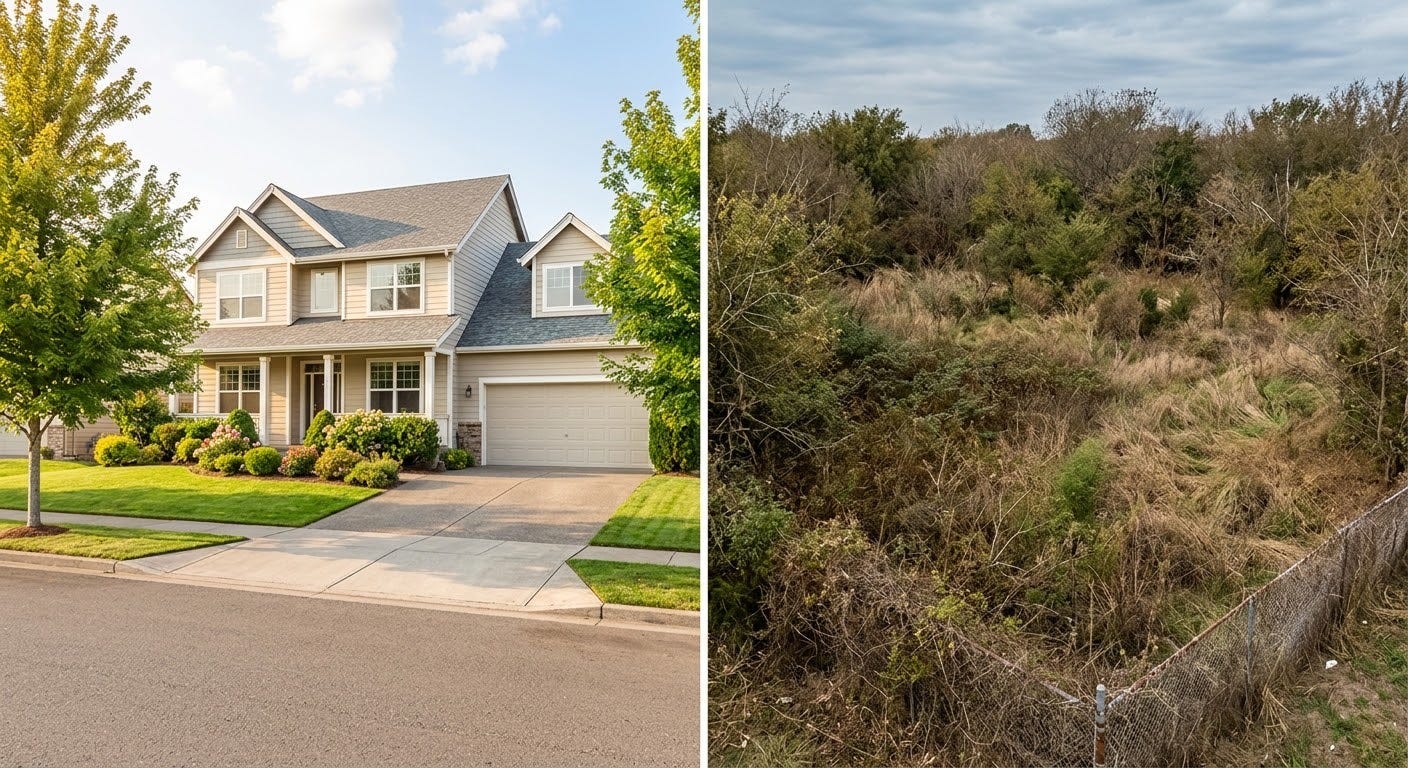
I thought I was buying a CD with a house behind it.
Years ago, when I first started learning about tax liens, that was the picture in my head. A fixed return, something solid behind it, and a day out in front of me when the money would come back.
I started in Florida, and I bought my first certificate there. For that one, the picture was close to literal. There was a house on it. I bought it over the counter, which meant straight from the county, without bidding at an auction. It redeemed in about three months. The money came back with the interest, and I thought I understood the whole thing.
I didn't look into its history. It had a house on it, and that seemed like enough.
What I thought I owned
Here is what a tax lien certificate actually is, as plainly as I can say it. When a property owner doesn't pay the yearly property tax, the county is owed that money. In Florida, the county sells that debt to an investor. The sale gets the county its money. It doesn't settle when the certificate holder gets theirs back. If the owner pays, the investor gets the money back with interest. If the owner doesn't, it can sit.
A tax lien does not give the investor the house. What you hold is a claim on someone else's unpaid tax bill. The property is only what stands behind the claim.
That is very different from a CD, which comes with a date. I kept thinking of it like a CD, and that shaped how I bought it.
There is a second path, and I never put a name to it. If the certificate sits long enough, the holder can ask the county to sell the property itself. That sale is called a tax deed sale. A tax lien is a claim on the bill. A tax deed is the sale of the property.
The one that didn't come back
The second one was just land. I bought it the same way, over the counter, and for the same reason: it was money I could ignore. The first redemption had shaped what I expected, whether I noticed it or not. I assumed this one would redeem within a year, at the outside.
It didn't, and while it sat there I started reading. I started with the county site. The first thing I saw was the list of parcels for the year. All of them were at 18%. I didn't have the knowledge or the experience to understand what I was looking at.
Later I understood it. The auction was already over when I bought. Certificates that got no bids at the auction were left over, and those were sold over the counter, all at that rate. I hadn't known when the auction was, where it happened, or how it worked. I came in after it ended and bought what was left. It never occurred to me to ask why it was left.
So I kept learning. I did more research, took some courses, and followed a mentor. The more I learned, the more I saw that I had walked into this thinking I knew what I was buying. I didn't.
As I learned how the process worked, that expectation faded. By about six months, the research had caught up with the purchase, and I understood what I had actually bought.
What I had missed was that the date lived in my head. The certificate never carried one. I had a window in mind, buy, wait, get paid, and nothing about the certificate promised it. The date I was waiting for was one I had supplied myself.
The land behind the claim
The rate was the same on every parcel on that list. I realized I never had a reason to buy mine beyond the rate.
While I waited, the property was passed over at the auction, year after year. Each year it went delinquent again, the new certificate got no bids, and each one went to the county. The property never changed hands. My certificate never came back.
When I pulled up the county's GIS records, I saw the parcel was landlocked, with no road access to it. I had only been thinking about the land, not how to actually get to it.
I won't say that the landlocked parcel explains every year of silence at the auction. I can only tell you what I saw, and what I took it to mean.
The records I never read
The history had been on the county site the whole time. I had looked at the price and the rate, and not much else. I could see that another investor had bought a certificate on that parcel every year before I did, and it gave me a false sense of security. I took it to mean someone had already done the checking. I never looked at what had happened to any of those certificates. None of them had been paid back.
I had only ever seen one ending, the first one. The other ending had already happened to other people, right there in the record.
I had also studied only one version of this, the one where it pays. Owner redeems, interest comes back, done. There are others, and I couldn't have named them. In one, the certificate sits. In Florida it stays valid for seven years, and if nobody has asked for a tax deed by then, it is cancelled and the claim is gone. In another, the holder asks for a tax deed sale, and the property goes to auction. That has its own steps and its own risks, and it isn't the same as getting paid back. I've since taken part in a tax deed auction myself, and I didn't win it. It was a different kind of room. You are bidding on the property itself, not on a rate. That is a separate story from this one, and my second certificate never went through that door.
Mine was the one that sat. After seven years, it was cancelled. The certificate is no longer open.
It isn't a hard document. I just never opened it. And I never priced how long I couldn't use the money.
Florida is where I started, and it's the only place I'm describing from experience. Since then I've learned that other states sell tax liens too, and they run it differently. Some sell the property itself instead of a lien. Sales also fall at different times in different places, which is why I keep a calendar. And a parcel's history only helps if you keep track of it, so I now keep a record of what happened at each sale and to each certificate.
Why the small amount mattered
The amount was small, and I treated it as a learning experience. It was money with no other job, so I didn't hold the purchase to the standard I'd have used on a bigger one. I also hadn't built the habit of checking.
Because the amount was small, I let myself skip the work. The work was the only thing that would have shown me the other ending.
I count the second one as a lesson in real life university. It sped up my learning. I learned that a high interest rate is no guarantee without the due diligence behind it.
Would I buy that certificate again, knowing what I know now? No.
If you want to follow this path as it develops — I'll write what I see. Subscribe below.