


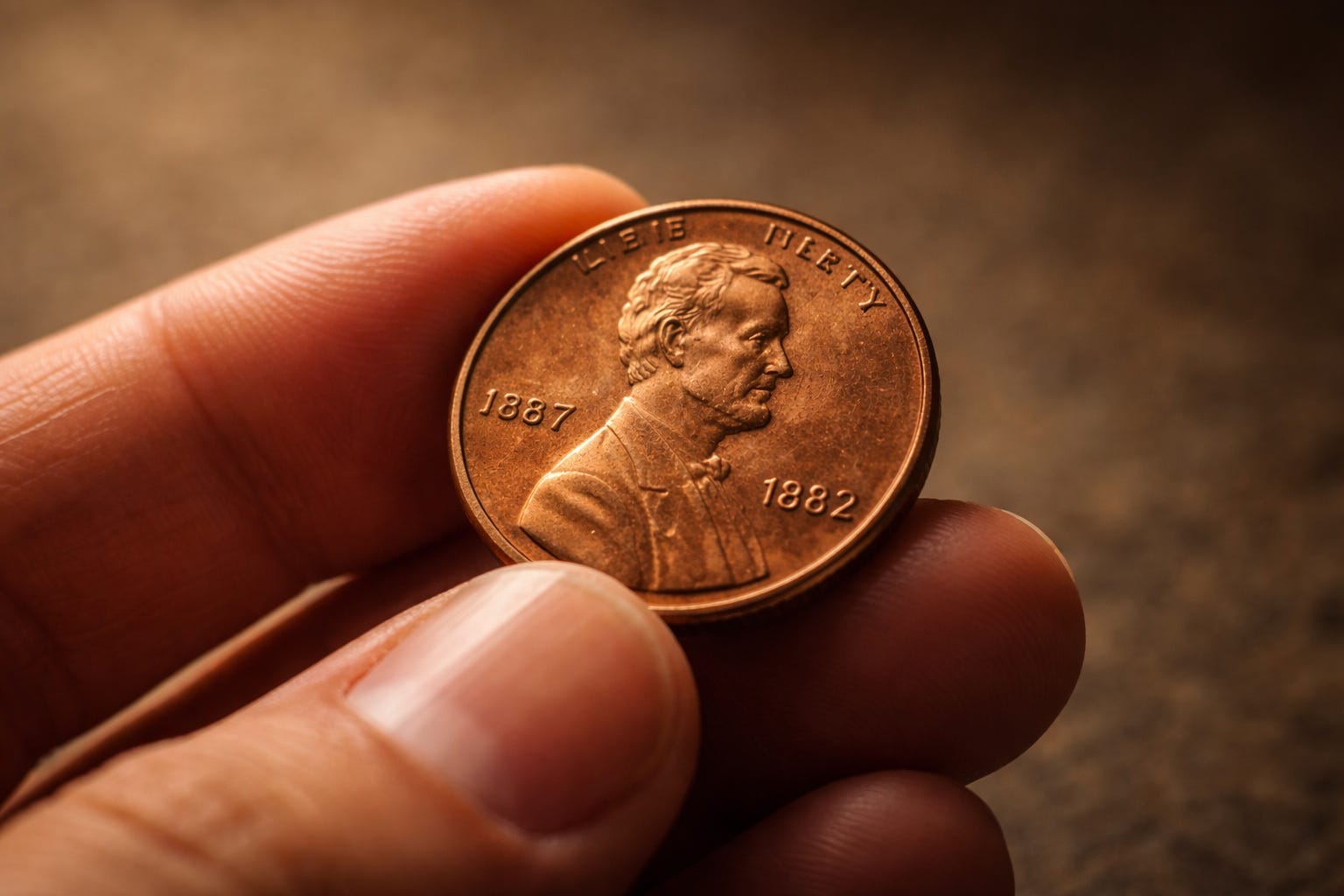
There’s a jar on your counter, or in your car, or stuffed in a drawer somewhere.
Pennies. Dozens of them. Maybe hundreds.
I knew they weren’t worth anything, but I still didn’t throw them away.
That contradiction—knowing they’re worthless but refusing to discard them—is worth paying attention to. Because it’s not irrational. It’s a signal. Your behavior is telling you something your thinking hasn’t caught up to yet.
Because what just happened to the penny isn’t a minor policy story about a coin. It’s a clean, datable example of what happens when a currency system debases its own unit — and then, forty-three years later, admits it can’t even afford the replacement.
The Order
In February 2025, President Trump ordered the U.S. Mint to stop producing pennies.
The stated reason was cost. In 2024, it cost 3.69 cents to make a one-cent coin. The Mint produced 3.2 billion of them and lost $85.3 million doing it — the nineteenth consecutive year production costs exceeded face value.
Nineteen consecutive years. Not a rounding error. Not a temporary supply disruption. A two-decade acknowledgment, buried in annual reports, that the system had already broken at its smallest unit — and kept going anyway.
But the cost problem didn’t start in 2025. It started in 1982.
I remember hearing about this problem years ago—that it cost more to make a penny than it was worth. I remember dismissing it the way you dismiss a lot of broken-system facts. One of those things that’s technically true but doesn’t matter because the system just keeps running.
But then I thought about the bubble gum machines.
I remember when gumball machines took pennies. Now I don’t even see those machines anymore. The smallest denomination that any machine will even take is a quarter. The system already adjusted. I just didn’t notice when.
That’s when it hit me: the system had already moved on without announcing it. Without asking permission. And I’d been living inside that adjustment the whole time without seeing it.
1982: When It Swapped
In 1982, the U.S. Mint changed what a penny was made of.
Before that year, a penny was 95% copper. Solid, dense, warm to the touch. The kind of metal that has held value across every civilization that ever used it.
After 1982, a penny became 97.5% zinc with a thin copper coating — a zinc disc wearing a copper mask. It looks the same. It spends the same. It costs less to make. And it contains almost none of the metal that gave the original coin its worth.
The reason was straightforward: copper had gotten expensive. The commodity inflation of the 1970s had pushed metal prices broadly higher. By the early 1980s, the copper in a penny was worth more than the coin itself. So rather than let the money system absorb that cost honestly, the government quietly swapped out the material.
The coin stayed the same on the outside. The substance changed on the inside.
This is what ancient wisdom calls debasement. The prophet Isaiah described it this way: *“Your silver has become dross.”* Dross is the waste material — the cheaper filler mixed in when a metal is stretched further than it should go. Isaiah wasn’t writing about coins. He was writing about a civilization losing its integrity. But the metaphor has held for 2,700 years because the mechanism never changes.
The 1982 penny is a modern dross coin. Not silver, not copper — zinc, dressed up to look like something it isn’t.
The 2006 Moment
By 2006, the copper inside a pre-1982 penny was worth more than a penny. The metal had appreciated while the face value stayed frozen.
The Mint’s response was not to acknowledge that the original coin held value. The response was to make melting illegal. In December 2006, new regulations made it a federal offense to melt pennies or nickels — carrying fines up to $10,000 and five years in prison.
Think about what that regulation actually says. It says: *the metal in this coin is worth more than the coin. And we’re making it illegal for you to access that value.*
The government, by making melting a crime, confirmed the thesis. You don’t make something illegal unless it’s worth doing. The copper was real. The face value was fiction.
By 2024, it cost 3.69 cents to produce a coin worth one cent. Copper prices had pushed past $5.50 per pound and climbing. The penny — the zinc one, the debased one — had become so expensive to produce that even the cheaper substitute couldn’t hold the line anymore.
I was actually angry when I learned all this. Not at the policy—but at myself. Because I had just deposited over a hundred dollars in loose change at the bank a few months earlier. I didn’t sort it. Didn’t check the dates. Just dumped it all into the machine and got my receipt.
And the only thought I had afterward was: how many pre-1982 pennies did I just hand back without even looking?
That was the moment it stopped being abstract. That was the moment I understood I’d been living inside this system without seeing it.
So they stopped making pennies.
What Still Exists
Here’s the part that most people miss.
There are still pre-1982 copper pennies in circulation. Not many — they’ve been slowly disappearing for decades, pulled out by collectors, lost, worn down, deposited without sorting. But they’re still out there. And with penny production now halted, the supply of all pennies is permanently closing.
Pre-1982 copper pennies are, at this point, a finite and shrinking resource. The Mint will not make more. The copper in them — 95% pure, 3.11 grams per coin — does not degrade. It does not inflate away. It is the same copper it was in 1975 or 1962 or 1943.
At current copper prices, a pre-1982 penny contains roughly 2.5 cents of metal. That’s a 150% premium over face value — sitting in a jar, or a sock drawer, or a roll from the bank.
Storing them is completely legal. Congress specifically declined to prohibit hoarding when the melting ban was written, noting that such a prohibition would be difficult to enforce and that citizens might unknowingly violate the rules. You can collect as many as you want. You cannot melt them. But you don’t need to melt them for them to serve a purpose.
There’s one more pressure on that supply worth knowing. When Canada ended its penny in 2012, the government melted most of the returned coins for their metal. The U.S. Treasury has the same legal authority here. If a recall happens, the pre-1982 copper pennies people deposit without sorting are gone. The window for finding them at face value closes quietly, the way most of these things do.
This is the same logic behind junk silver. In 1965, the government did to dimes and quarters exactly what it did to pennies in 1982 — pulled the real metal out and replaced it with something cheaper. Before 1965, a dime was 90% silver. After 1965, it was copper-nickel clad. The silver disappeared from circulation almost immediately, because people recognized the difference between a coin that contained something and one that merely represented something. Pre-1965 coins became known as “junk silver” — not because they’re worthless, but because they’re ordinary circulated coins whose value comes from the metal, not from rarity or condition.
Nobody holds junk silver to melt it next week. They hold it because it is a recognized form of metal with a known composition and a face value floor. The worst case is that it spends as money. The better case is that the metal inside is worth more than the number stamped on the front.
Pre-1982 pennies are the third tier of that same system.
Why the Bible Noticed This First
Matthew 10:9 records Jesus sending out his disciples with a specific instruction about money. He lists what not to carry: gold, silver, or copper.
Three tiers. Three metals. A hierarchy that most of the world recognized for most of human history.
Gold for large transactions and reserves. Silver for commerce. Copper for the smallest, most everyday exchanges — the kind that actually reach ordinary people.
The penny, before 1982, was copper money in that original sense. It had weight. It had substance. It was the lowest tier of a real system.
What replaced it in 1982 was not copper money. It was a symbol — a zinc token that looks like a coin and functions like a coin but contains no meaningful store of value. A placeholder. A receipt for one cent, backed by the government’s willingness to honor it.
Ancient societies understood that when rulers began substituting base metals into their coinage, it was a signal — not necessarily of conspiracy, but of pressure. The system was being stretched. The substance was being hollowed out. Isaiah’s “silver become dross” wasn’t a moral complaint about metallurgy. It was an observation about what happens to institutions when they stop valuing what they claim to value.
The penny’s death in 2025 is that observation made into a news story.
How to Actually Notice
This isn’t an argument to panic. It’s an argument to notice.
The pre-1982 copper penny is one of the lowest-barrier entry points into alternative metal infrastructure that exists. You don’t need a brokerage account. You don’t need to understand futures markets. You don’t need to spend money you don’t have.
You need to go to a bank, ask for rolls of pennies, and sort them by date. Anything before 1983 is copper. Anything 1983 and after is zinc. The copper ones weigh 3.11 grams. The zinc ones weigh 2.5 grams. If you have a small postal scale, you can sort them without even reading the date. The copper ones make a distinct ring when dropped. The zinc ones sound like a dull thud.
That’s the entire system. Copper on one side. Zinc on the other.
For the copper ones, you’re holding metal at face value. The floor is one cent — it’s still legal tender. The ceiling moves with copper prices, which have been rising structurally for a decade driven by electrification, AI infrastructure, and tightening global supply. Copper is currently trading around $5.60 per pound — more than double what it was when the Mint first ran into trouble in 2006.
Then consider what happened in 2025. The Trump administration declared copper a national security concern, launched a federal investigation into America’s dependence on foreign copper, and ultimately imposed a 50% tariff on copper imports in July 2025.
That sequence is worth tracing slowly. The same government that in 1982 quietly stripped copper out of your pocket change because it had gotten too valuable — is now treating copper as a strategic asset worth protecting with tariffs and federal investigations.
That’s not irony. That’s the confession the subtitle promised. The metal they removed from circulation is now the metal they’re scrambling to secure. And you can still find it in bank rolls for one cent apiece.
The Quiet Takeaway
This is not investment advice and not a price prediction — it’s an observation with a one-cent entry point. A way to hold something real. The education comes free with the coin.
The system did something in 1982 that most people never noticed. It changed what money was made of — not dramatically, not with a press conference, but quietly. Efficiently. Because the incentives pushed in that direction and nothing pushed back.
It spent the next forty years manufacturing the replacement at a loss, admitting the problem only when it became impossible to ignore.
Then it stopped.
If you have a jar of pennies somewhere, you might want to sort through them before they disappear entirely. The copper ones are not going to make you rich. But they are going to stay copper.
That’s more than most things can promise.
If you want to follow this path as it develops — I'll write what I see.
Subscribe below.