



I went to withdraw cash from my bank.
Not a wire. Not a transfer. Cash. From a bank.
They asked me to schedule it.
Two days out. They needed time to have it ready.
I stood there looking at the teller with one thought: what is that vault for.
Because the money was there. It was mine. I could see the number. I just couldn’t have it that day.
That’s not a bank problem. That’s the system telling you something plainly, if you’re listening. The money is accessible — on their schedule, in their amount, on their terms.
Liquid. Not free.
It turns out the feeling has numbers behind it.
The Federal Reserve’s Financial Accounts report shows household checking and savings balances at $18.1 trillion as of Q3 2024, up 47% from pre-pandemic levels. Money market fund assets reached $6.3 trillion in late 2024, roughly double their 2019 size.
People are holding more cash than they have in decades.
At the same time, the Federal Reserve Bank of New York reports household financial stress approaching levels last seen in 2020. Credit card delinquencies crossed 3% in Q2 2024. Personal savings rates fell to 4.8%, well below the 7.5% pre-pandemic average.
More cash. More stress.
The contradiction is structural, not psychological.
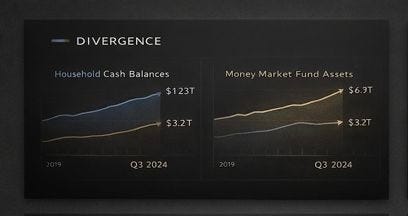
The issue isn’t how much liquidity exists. It’s who controls it—and what it can do when you need it most.
Your liquidity is someone else’s float
Modern liquidity is not the same as accessible capital.
When you deposit money in a bank, you receive liquidity—the ability to withdraw funds on demand. What you do notreceive is ownership control. The bank records your deposit as a liability, then lends against it at 7–12% interest. You earn 0.5–2%, if anything.
This is fractional reserve banking. It works until everyone wants their money at once.
In March 2023, Silicon Valley Bank collapsed in 48 hours. Depositors had liquidity in theory. In practice, $42 billionexited in a single day through digital transfers. Liquidity was restored only after government intervention.
Money market funds operate under similar assumptions.
They promise stability—$1 per share—maintained through accounting conventions, liquidity backstops, and policy confidence. In September 2008, the Reserve Primary Fund broke that promise after Lehman defaulted on commercial paper. Withdrawals were frozen. A Treasury guarantee was created to stop the run.
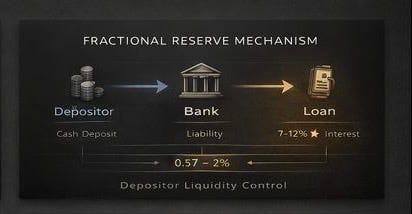
The pattern is consistent:
Liquidity depends on confidence. Confidence depends on policy.
This is not a critique. It’s system design.
Your liquidity is someone else’s float.
Money at rest earns them nothing
Financial institutions optimize for money in motion, not money at rest.
Banks earn when deposits stay put and loans remain outstanding. Brokerages earn when capital rotates through products. Fintech platforms earn when users move money between features, accounts, and incentives.
Idle capital generates little revenue.
So the system encourages movement—rebalancing, sweeping, trading, upgrading, optimizing.
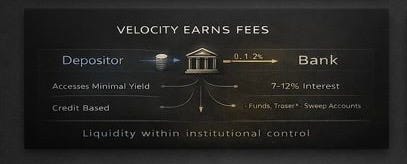
Liquidity, in this environment, means conditional access:
You can move money within approved rails.
You can transfer between institutions on approved timelines.
You can withdraw—until controls appear.
What you cannot do is quietly exit the system without converting your capital into something else.
Holding it without handing it over
Certain structures preserve access without surrendering control. They cost more upfront. They compound differently. They are rarely taught—because they compete with velocity-based products.
Whole life: a vault you can borrow from
Whole life insurance is commonly framed as a death benefit with cash value as a side effect. This framing obscures the actual mechanism.
A properly structured whole life policy builds guaranteed cash value. After early years, you can borrow against that value via policy loans:
No credit approval
No usage restrictions
No repayment schedule enforcement
Typical policy loan rates range 5–8%.
Here’s the structural distinction:
You are not withdrawing capital. You are borrowing against it—while it continues to compound.

Example:
You need $50,000.
Bank loan at 9% over 5 years → $12,748 interest paid
Policy loan at 5% → $6,893 interest paid
Your cash value continues compounding uninterrupted
The difference is not just rate. It’s who captures the spread.
Whole life is inefficient for maximizing market returns. It is efficient for private liquidity, internal financing, and control.
Silver: the part no one can freeze
Silver is physical, divisible, and has no counterparty.
Bank accounts rely on banks. Funds rely on custodians. Brokerages rely on clearing systems.
Silver relies on none of them.
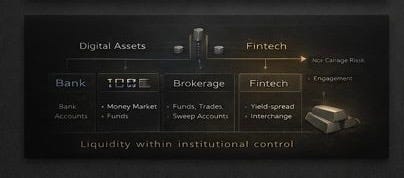
Silver does not yield. It does not compound. It fluctuates.
What it does is exist independently.
No institution can freeze it. No algorithm gates access. No policy decision alters ownership.
The tradeoff is real:
Storage responsibility
Verification friction
Conversion delay
But if liquidity includes control, silver functions as a quiet reserve—not an investment.
Why no one teaches this
Retail finance is designed to maximize float and velocity, not optionality.
Whole life removes capital from AUM models. Silver removes deposits from the banking system.
Education follows incentives.
Advisors teach what aligns with how they are paid:
Emergency funds in banks
Long-term savings in managed portfolios
Liquidity defined as institutional access
This advice optimizes for returns and simplicity—not autonomy.
The result is liquidity without leverage when conditions change.
What liquid should actually mean
Quiet liquidity is access to capital without permission, without forced liquidation, and without policy dependence.
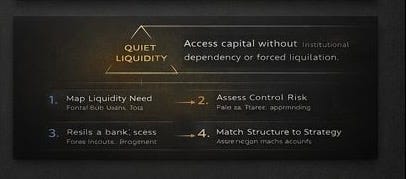
Practical Starting Points
Map real liquidity needs Fixed expenses, crisis expenses, opportunity capital.
Evaluate whole life as infrastructure, not investment Focus on guarantees, loan terms, and long-term borrowing efficiency.
Hold physical silver proportionally As insurance against system friction—not as speculation.
Compare lifetime costs, not annual yields Liquidity architecture reveals itself over decades.
If you’re holding cash you’re proud of, it’s probably sitting somewhere built to keep it moving through someone else’s system — not built to leave you in control of it. That’s not wrong. It’s just half the picture.
The other half costs more upfront. It builds slower. It asks you to think for yourself instead of taking the default. But it’s real, it’s available, and most of it has been sitting in plain sight the whole time.
The exits are already in the room. Most people just don’t know where to look.
If you want to follow this path as it develops — I'll write what I see.
Subscribe below.