

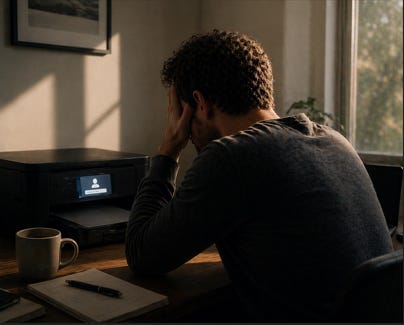
I tried to print something the other day.
Just a simple document.
Same printer I’ve had for years. Same desk. Same setup.
I didn’t think about it. I just hit print like I always do.
Nothing happened.
Not broken. Not dramatic.
Just a pause… and then a prompt asking me to sign in.
To print something sitting three feet away from me, I had to log into an account I don’t remember creating for a printer I already owned.
That was the first time I stopped.
Not because something failed.
Because something familiar didn’t behave like it used to.
I assumed it was a one-off.
So I tried again a few days later.
Different document.
Same printer.
Same result — but now it wanted an app update before it would continue.
The printer hadn’t changed.
The way I accessed it had.
That’s when I noticed the pattern.
Printing wasn’t failing.
It wasn’t even complicated.
It had just stopped being direct.
I remembered how it used to feel.
You clicked print. It printed.
That was it.
No account. No authentication. No conditions.
Just intention → output.
Now there’s always something in between.
A login. A driver. An update. A verification step.
Not enough to stop you.
Just enough to make you participate in the process of accessing something you already own.
And the strange part is how quickly you adjust.
You don’t stop printing.
You just stop expecting it to be immediate.
That was the shift I didn’t notice at first:
Nothing stopped working.
It stopped being direct.
Once I saw it with printing, I started seeing it everywhere.
Software I already had required sign-ins to function.
Devices I already owned behaved differently after updates.
Things I had already set up… needed to be set up again.
But printing made it visible.
Because printing used to be the one thing that didn’t require negotiation.
Now it does.
Every time.
At some point I stopped seeing these as separate problems.
They became one repeating experience:
You return to something you already have… and access is no longer automatic.
That’s the sharper realization:
Returning is no longer enough.
There was a time when that wasn’t true.
Not in theory — in practice.
If something was set up, it stayed set up.
If something was yours, it stayed directly usable.
You didn’t have to re-establish it every time you came back to it.
That contrast made something older come to mind.
In Genesis 1, man is placed into what already exists and given responsibility over it.
Not access to be revalidated.
Not ownership to be maintained.
Stewardship — inside a stable structure.
That’s the part that sticks.
Not as doctrine.
Just as comparison.
Because whatever we call this now, it doesn’t behave like that anymore.
We didn’t lose ownership. We replaced it with systems where ownership is conditional on access.
That’s the shift.
Not dramatic.
Just continuous.
Nothing was taken.
No single moment changed anything.
It just became normal to re-enter things instead of simply return to them.
And printing made that visible.
Because it used to be the one thing that didn’t require thinking.
Now it does.
Every time.
And once you notice it, it stops feeling like inconvenience.
It starts feeling like structure.
Not everything is disappearing.
But very little is simply “there” anymore without conditions attached to it.
And that changes the question completely.
Not what you own.
Not what you can access.
But —
what still responds the same way every time you return to it.
If you want to follow this path as it develops — I’ll write what I see.
Subscribe below.
Interesting because it resists the pressure to constantly perform scale publicly.
A lot of sustainable growth happens quietly long before it becomes legible externally.